

Selecting the correct oil filter is paramount for maintaining engine health and longevity. This comprehensive guide will walk you through understanding your vehicle’s specific needs, exploring different types of oil filters, matching them with your engine oil, and decoding essential filter specifications. By making an informed choice, you can ensure optimal filtration, proper oil flow, and robust protection for your engine.
Use the oil filter recommended by your vehicle’s manufacturer, listed in the owner’s manual. Choose the correct size and thread type. For better protection, use a high-quality or OEM filter with a good anti-drainback valve and proper filtration rating, especially for modern or high-mileage engines.
What Type of Oil Filter Should I Use?
Welcome, fellow car enthusiast and meticulous maintenance maestro! If you’re reading this, you probably understand that changing your engine oil is one of the most vital tasks for keeping your ride running smoothly. But here’s a secret: choosing the right *oil filter* is just as important as the oil itself. It’s not just a canister you screw on; it’s your engine’s silent guardian, diligently catching contaminants before they can wreak havoc.
This guide isn’t just about picking *an* oil filter; it’s about helping you pick the *best type of oil filter* for *your* specific vehicle, driving style, and the engine oil you use. We’ll demystify the jargon, explore different filter types, and arm you with the knowledge to make an informed decision. By the end, you’ll know exactly what to look for, ensuring your engine gets the protection it deserves. Let’s dive in!
Key Takeaways
- Consult Your Owner’s Manual First: Always start by checking your vehicle’s owner’s manual for OEM recommendations on the type and specifications of oil filter to use. This is your primary source for ensuring compatibility and performance.
- Match the Oil Filter to Your Engine Oil: The type of engine oil you use (conventional, synthetic blend, or full synthetic) should dictate your oil filter choice. A full synthetic oil performs best with a full synthetic oil filter for maximum protection and extended drain intervals.
- Understand Filter Media and Micron Rating: Oil filters use different media (cellulose, synthetic, blend). Synthetic media generally offers finer filtration (lower micron rating) and better flow, crucial for modern engines and extended oil change intervals.
- Don’t Overlook Bypass and Anti-Drain Back Valves: The bypass valve ensures oil still reaches the engine if the filter is clogged or oil is cold. The anti-drain back valve prevents oil from draining out of the filter when the engine is off, critical for quick lubrication on startup. Both must match OEM specifications.
- Consider Driving Habits and Environment: Your driving conditions (heavy-duty, stop-and-go, dusty) influence the demand on your engine and oil filter. More severe conditions warrant a higher-quality, more robust oil filter capable of superior filtration and durability.
- Quality Matters – Choose Reputable Brands: Opt for oil filters from well-known, reputable brands (OEM or trusted aftermarket) that adhere to high manufacturing standards. Generic or unknown filters can compromise engine protection due to poor quality or incorrect specifications.
Quick Answers to Common Questions
Should I always use an OEM oil filter?
While OEM (Original Equipment Manufacturer) oil filters guarantee a perfect fit and performance as specified by your car’s maker, many reputable aftermarket brands offer filters that meet or even exceed OEM specifications. Choosing a high-quality aftermarket filter is perfectly fine, especially if it matches your specific oil and driving needs.
Can I use a synthetic oil filter with conventional oil?
Yes, you can absolutely use a full synthetic oil filter with conventional oil. It will provide superior filtration and better flow than a standard filter. However, it’s generally considered overkill and not cost-effective, as the conventional oil will still need to be changed at its regular, shorter interval, negating the extended-life benefit of the synthetic oil filter.
What happens if I use the wrong size oil filter?
Using the wrong size oil filter can lead to severe problems. If it’s too small or has the wrong thread pitch, it won’t seal properly, causing oil leaks and potentially significant oil loss. If it’s too large, it might not fit in the designated space or could also lead to sealing issues. Always match the filter to the OEM specifications.
How often should I change my oil filter?
The general rule of thumb is to change your oil filter every time you change your engine oil. While some extended-life oil filters are designed to last for longer oil change intervals with synthetic oils, it’s still best practice to replace the oil filter alongside the oil to ensure optimal filtration and engine protection.
Is a magnetic oil filter worth it?
Magnetic oil filters (or filters with integrated magnets) are designed to capture microscopic ferrous metal particles that the filter media might miss. While not strictly necessary for most engines with regular maintenance, they can offer an extra layer of protection, especially in older engines or those prone to higher wear. They are often found in high-performance or heavy-duty filters.
Step 1: Understand Your Vehicle’s Specific Needs
Before you even think about brands or types, the first and most critical step is to understand what your vehicle *needs*. Your car’s manufacturer knows best, and their recommendations are gospel.
Consult Your Owner’s Manual
This is your primary bible for all things related to your car’s maintenance. Somewhere in those pages, you’ll find detailed specifications for the recommended *oil filter*. It will often list a specific part number (OEM or cross-referenced) or, at the very least, general characteristics. The manual will also tell you the recommended oil viscosity and type, which directly influences your filter choice. Don’t skip this step – it’s the foundation of a correct *oil filter* selection.
Identify Your Engine and Application
Are you driving a compact sedan, a heavy-duty pickup truck, a performance sports car, or something in between? The type of engine (e.g., small displacement four-cylinder, large V8 diesel) and its intended application significantly impact the demands on your *oil filter*. A race car needs a different filter than a commuter car, and a truck towing heavy loads requires more robust filtration than one used for light errands. Consider the environment your engine operates in.
Step 2: Get to Know the Different Types of Oil Filters
Not all *oil filters* are created equal. They vary significantly in construction, media, and intended use. Understanding these differences is key to choosing the right one.
Standard (Conventional) Oil Filters
These are your basic, entry-level *oil filters*. They typically use a cellulose-based filter media (which looks like thick paper) to trap contaminants.
Pros: Affordable, widely available, suitable for conventional engine oils and standard oil change intervals (e.g., every 3,000-5,000 miles).

Visual guide about What Type of Oil Filter Should I Use?
Image source: 5.imimg.com
Cons: Generally offer less efficient filtration than synthetic filters, can degrade faster, and aren’t designed for extended oil change intervals or synthetic oils.
Use this type of oil filter if you’re using conventional oil and changing it frequently.
Synthetic Blend/Extended-Life Oil Filters
Stepping up from conventional filters, these feature a blend of synthetic and cellulose fibers in their filter media. This combination provides better filtration efficiency and durability than standard filters.
Pros: Improved filtration, can handle slightly longer oil change intervals, good match for synthetic blend oils. They offer a good balance of performance and cost.
Cons: More expensive than standard filters, not quite as robust as full synthetic filters.
This type of oil filter is a solid choice if you use synthetic blend oils or are looking for a bit more protection than a standard filter offers without the full synthetic price tag.
Full Synthetic Oil Filters
These are the premium choice, featuring advanced synthetic filter media designed for superior filtration, higher flow rates, and exceptional durability. They are built to last for extended oil change intervals, often up to 10,000-20,000 miles, making them ideal companions for full synthetic engine oils.
Pros: Best filtration efficiency (trapping smaller particles), excellent flow characteristics (reducing pressure drop), high capacity for contaminants, and extreme durability. Perfect for extended drain intervals.
Cons: Highest cost among filter types.
If you use full synthetic oil and want maximum engine protection and the ability to go longer between changes, a full synthetic oil filter is the way to go.
High-Performance/Racing Oil Filters
Designed for demanding conditions, these *oil filters* prioritize high flow rates to ensure sufficient oil supply under extreme engine loads and RPMs. They often feature robust construction, high-strength media, and sometimes even magnetic elements to capture ferrous metal particles.
Pros: Excellent flow, very durable, often features added benefits like magnetic filtration.
Cons: Can be very expensive, might not offer the absolute finest filtration (prioritizing flow), often overkill for daily drivers.
Cartridge vs. Spin-On Filters
Beyond the media, *oil filters* also come in two main physical configurations:
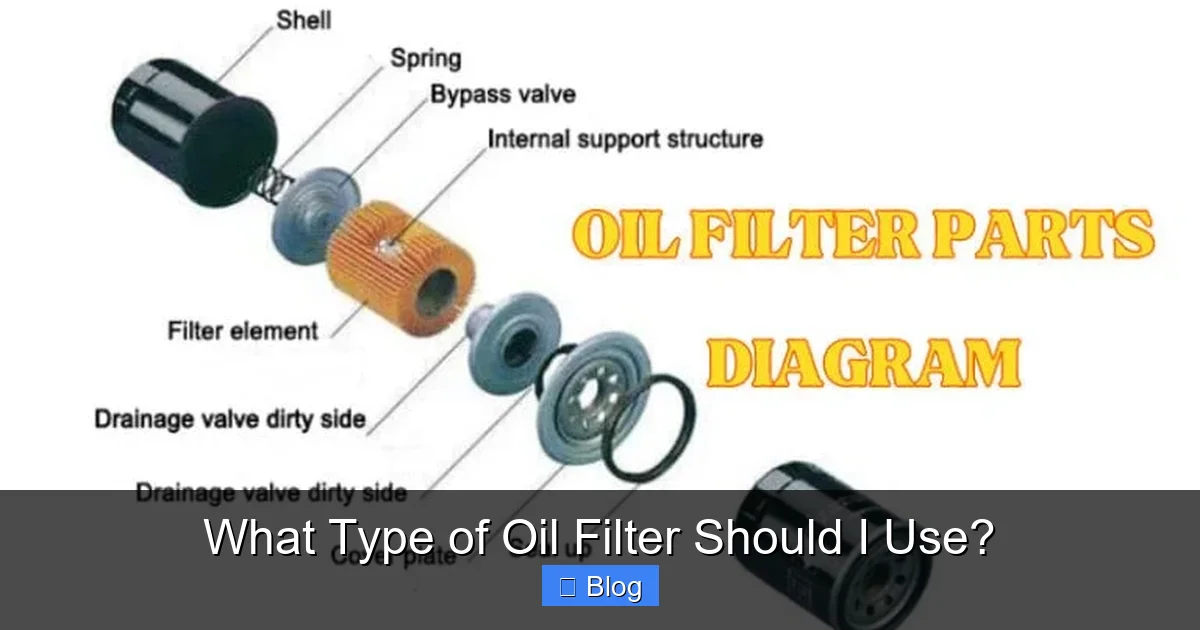
- Spin-On Filters: These are the most common type. They consist of a metal canister containing the filter media, bypass valve, and anti-drain back valve. You simply thread the whole unit onto a mounting stud on the engine block.
- Cartridge Filters: Increasingly popular in newer vehicles, these consist of just the filter element (the “cartridge”) without the metal canister. The cartridge is inserted into a reusable housing built into the engine, often accessed from the top or bottom of the engine. While the method of replacement differs, the principles of choosing the right filter media type (standard, synthetic blend, full synthetic) still apply. Always ensure you get the exact OEM-specified cartridge for your vehicle.
Step 3: Match Your Oil Filter to Your Engine Oil
Visual guide about What Type of Oil Filter Should I Use?
Image source: mechanicfixa.com
This is where many people make a common mistake. You wouldn’t put cheap gas in a performance car, right? The same logic applies to your *oil filter* and engine oil. They work together as a system.
Conventional Oil and Standard Filters
If you’re using conventional engine oil, a standard cellulose *oil filter* is usually sufficient. It’s a budget-friendly combination for vehicles with normal driving conditions and shorter oil change intervals.
Synthetic Blend Oil and Enhanced Filters
For synthetic blend oils, pairing them with a synthetic blend or extended-life *oil filter* makes the most sense. This combination provides better protection and allows for slightly longer intervals than conventional setups, striking a balance between cost and performance.
Full Synthetic Oil and Full Synthetic Filters
This is the optimal pairing for maximum engine protection and extended drain intervals. If you’re investing in full synthetic oil, which offers superior protection, stability, and extreme temperature performance, you absolutely want a full synthetic *oil filter* to match. A cheap, standard filter will become the weak link, negating many of the benefits of your premium oil by not filtering efficiently enough or degrading before the oil’s lifespan is up. Don’t cheap out on the filter if you’re using synthetic oil; it’s counterproductive.
Step 4: Decode Key Oil Filter Specifications
Beyond the basic types, several technical specifications define an *oil filter*’s performance. Understanding these will help you compare options.
Micron Rating
This number tells you the size of the smallest particles the filter can effectively capture. A lower micron rating means finer filtration (it catches smaller particles). For example, a filter rated at 20 microns will stop particles 20 micrometers or larger. High-quality synthetic *oil filters* often boast efficiency ratings like “99% efficiency at 20 microns,” meaning they remove 99% of particles larger than 20 microns.
Flow Rate (and Pressure Drop)
An *oil filter* must allow enough oil to flow through it to keep your engine properly lubricated. Too much restriction (high pressure drop) can starve parts of the engine for oil, especially during cold starts or high RPMs. Quality filters balance effective filtration with minimal restriction, ensuring adequate oil flow without compromising engine protection. Your vehicle’s OEM specifies the required flow characteristics.
Bypass Valve Pressure Setting
Every *oil filter* has a bypass valve. If the filter media becomes clogged, or if the oil is very thick (like during a cold start in winter), this valve opens to allow unfiltered oil to flow to the engine. This is a failsafe to prevent oil starvation. The critical part is that the bypass valve must open at the correct pressure setting specified by your vehicle’s manufacturer. If it opens too soon, oil might bypass the filter too often. If it opens too late, oil starvation could occur before it opens. Always choose an *oil filter* with the correct bypass valve setting.
Anti-Drain Back Valve (ADBV)
Many modern spin-on *oil filters* include an anti-drain back valve, usually made of silicone or nitrile rubber. Its purpose is to prevent oil from draining out of the filter and back into the oil pan when the engine is turned off. This ensures that the *oil filter* and oil galleries remain full, providing immediate lubrication to critical engine components during cold starts. A poorly designed or faulty ADBV can lead to “dry starts” and increased engine wear. Silicone ADBVs are generally superior to nitrile, especially in extreme temperatures.
Filter Media Material
As discussed, the media can be cellulose, a synthetic blend, or full synthetic.
- Cellulose: Cost-effective, good for basic filtration, but capacity and durability are limited.
- Synthetic Blend: Improved performance over cellulose, good balance.
- Full Synthetic: Best for filtration efficiency, capacity, durability, and flow. It’s what you want for extended drain intervals and high-performance engines.
Step 5: Consider Your Driving Habits and Environment
Your personal driving style and the conditions you drive in should also influence your *oil filter* choice.
Normal Driving
If you mostly drive on highways and in light city traffic, with regular oil change intervals, a standard or synthetic blend *oil filter* paired with appropriate oil might be sufficient.
Stop-and-Go/City Driving
Frequent short trips, idling, and stop-and-go traffic put more stress on your engine and oil. This “severe service” environment often means more contaminants build up faster. A higher-quality synthetic blend or full synthetic *oil filter* is recommended here to handle the increased demands.
Heavy-Duty Use/Towing
If you frequently tow heavy loads, carry maximum cargo, or engage in demanding tasks, your engine operates under significant stress. High engine temperatures and pressures demand the best protection. A robust, full synthetic *oil filter* is crucial to ensure optimal filtration and flow under these harsh conditions.
Dusty Conditions/Off-Roading
Driving in dusty environments or off-road exposes your engine to a higher concentration of airborne particles. These can find their way into the oil, requiring superior filtration. A high-capacity, full synthetic *oil filter* with excellent micron ratings is a must to protect your engine from abrasive wear.
Step 6: Choosing a Brand and Quality Level
Once you know the type and specifications you need, it’s time to pick a brand. Not all brands are created equal, and even within a brand, there are different tiers of *oil filters*.
OEM Filters
Original Equipment Manufacturer (OEM) *oil filters* are designed specifically for your vehicle by the manufacturer. They guarantee a perfect fit and compliance with all specifications. While often pricier, they are a safe and reliable choice.
Reputable Aftermarket Brands
Many aftermarket companies produce excellent *oil filters* that often meet or exceed OEM specifications. Look for well-known brands that have a reputation for quality. Examples include:
- Wix: Known for solid construction and good filtration.
- Mobil 1: Offers premium full synthetic filters designed for extended performance.
- K&N: Popular for high-flow filters, often with a focus on performance.
- Fram: Has various tiers, from basic (Extra Guard) to premium synthetic (Ultra Synthetic). Research their specific lines.
- Bosch: Offers a range of quality filters, including those designed for synthetic oils.
- Purolator: Known for their quality and different tiers, including synthetic.
Always research specific models within these brands. A brand’s “entry-level” filter might be comparable to another’s “mid-tier.”
Avoid Generic or Unknown Brands
While tempting due to lower prices, generic or obscure *oil filter* brands can be a gamble. They might use inferior materials, have incorrect bypass valve settings, or poor construction, leading to inadequate filtration, oil leaks, or even engine damage. Engine protection is not an area to cut corners.
Troubleshooting Common Oil Filter Issues
Even with the right knowledge, sometimes things can go wrong. Here are a few common issues related to *oil filter* selection and installation:
Wrong Fit
If your new *oil filter* doesn’t thread on smoothly or seems too loose/tight, you likely have the wrong size or thread pitch. Do not force it! Forcing it can damage your engine block’s threads, leading to severe oil leaks. Double-check the part number against your owner’s manual or a reliable parts catalog.
Low Oil Pressure Warning After Filter Change
If you get a low oil pressure warning shortly after an oil and filter change, it could be due to a few reasons:
- Incorrect Bypass Valve Setting: If the bypass valve opens too late, it can restrict flow.
- Clogged Filter (Rarely, if new): A defective new filter could be clogged, though this is uncommon.
- Faulty Anti-Drain Back Valve: If the ADBV isn’t holding oil, it can cause a momentary pressure drop on startup.
- Improper Installation: Always ensure the filter is properly tightened, and the old gasket hasn’t stuck to the engine block.
Oil Leaks After Change
The most common cause of leaks after an *oil filter* change is improper installation. Always ensure the rubber gasket on the new filter is properly seated and lubricated with a little fresh oil before tightening. Also, check that the old gasket didn’t stick to the engine block when you removed the old filter – if two gaskets are present, it will leak! Finally, ensure you have the correct filter for your vehicle; an incorrect size can prevent a proper seal.
Conclusion: Drive with Confidence
Choosing the right *oil filter* isn’t a trivial decision; it’s a critical component of your vehicle’s preventative maintenance and overall engine health. By understanding your vehicle’s specific needs, the various types of filters available, and how to match them with your engine oil and driving habits, you’re empowered to make a choice that genuinely protects your investment.
Remember to always prioritize quality, consult your owner’s manual, and don’t hesitate to opt for a premium *oil filter* if you’re using synthetic oil or driving in demanding conditions. A little extra spent on a quality filter can save you a lot of headache and expense down the road. Drive with confidence, knowing you’ve given your engine the best possible protection against harmful contaminants.

Sagor Jahan is the founder and author of Automopromo.com, dedicated to delivering insightful tips, reviews, and updates in the automotive and promotional industry. With a passion for innovation and clear guidance, Sagor helps readers make informed decisions and stay ahead in the ever-evolving automotive world.

