
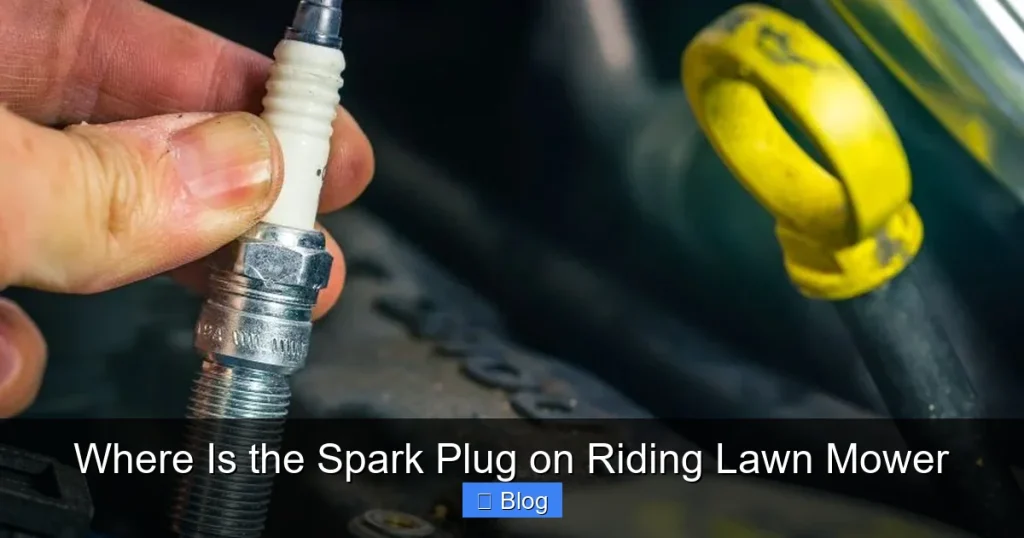
Where is the spark plug on riding lawn mower? The spark plug is usually located on the side or front of the engine, connected to a thick rubber wire (spark plug wire). It sits in the cylinder head and is often easy to spot once you open the mower’s hood.
In most riding lawn mowers, the engine is positioned under the hood at the front. Look for a small, metal-tipped component with a wire attached—this is the spark plug. Depending on the model, it may be slightly hidden behind engine covers, but the attached wire makes it easier to identify quickly.
Knowing the spark plug’s location helps with basic maintenance like cleaning or replacement. Regularly checking it ensures your mower starts smoothly, runs efficiently, and avoids common engine problems during use.
Key Takeaways
- Prioritize Safety: Always disconnect the spark plug wire, remove the ignition key, engage the parking brake, and allow the engine to cool completely before attempting to locate or work on the spark plug.
- Understand Engine Types: Spark plug location largely depends on whether your riding mower has a single-cylinder or V-twin engine, and its orientation (vertical/horizontal shaft).
- Identify the Spark Plug Wire: The spark plug is always connected to a thick, insulated, rubbery wire (the spark plug boot) that delivers electrical current from the ignition coil. Following this wire is the most reliable way to find it.
- Common Locations: On most single-cylinder engines, the spark plug is on the front or side of the engine block. For V-twin engines, there will be one on each cylinder, often on opposite sides.
- Consult Your Owner’s Manual: If you’re struggling to find it, your mower’s owner’s manual is the ultimate resource, providing diagrams and specific location details for your model.
- Gather the Right Tools: A spark plug wrench or socket (typically 5/8″ or 13/16″), a ratchet, and an extension are essential for safe and effective spark plug removal and installation.
Quick Answers to Common Questions
What if I find two spark plug wires?
If you find two spark plug wires, it means your riding lawn mower has a V-twin engine. This is completely normal! Simply follow each wire to its respective spark plug. You’ll have one spark plug for each cylinder, often on opposite sides of the engine block.
Can the spark plug be hidden under a cover?
Yes, absolutely. Some riding lawn mower engines, especially newer ones, might have plastic or metal shrouds and covers designed for aesthetics or protection. You may need to remove these covers (usually held by screws or clips) to fully expose the engine and locate the spark plug. Always refer to your owner’s manual if you’re unsure how to remove a cover.
What if the spark plug wire is stuck?
The spark plug boot can sometimes seize onto the spark plug due to heat and time. Try gently twisting the boot left and right while pulling firmly and steadily. Avoid yanking it forcefully, as this could damage the wire or the boot itself. If it’s still stuck, a small amount of penetrating oil around the base of the boot (be careful not to get it on the wire itself) might help, but ensure you wipe it clean before reconnecting.
Do all riding mowers have the spark plug in the same general area?
While the exact position varies, the spark plug will always be found screwed into the cylinder head of the engine block. The general area is typically on the front, side, or sometimes rear of the main engine unit. Differences largely depend on whether it’s a single-cylinder or V-twin engine and the mower’s chassis design (front-engine vs. rear-engine).
Why is it so important to disconnect the spark plug wire first?
Disconnecting the spark plug wire is a critical safety step because it completely cuts off the ignition system to the spark plug. This prevents accidental engine starts or electrical shocks while you are working near the engine, ensuring your safety during maintenance or inspection.
Safety First: Essential Precautions Before You Start
Before you even think about putting your hands near your riding lawn mower’s engine, safety must be your absolute top priority. Working on any engine involves potential hazards, and taking a few moments to prepare can prevent accidents and injuries. This isn’t just a suggestion; it’s a critical step that should never be skipped when trying to find the spark plug on your riding lawn mower.
Disconnect the Spark Plug Wire
This is arguably the most important safety step. The spark plug wire carries high voltage, and accidentally touching it or having the engine crank while your hands are near can cause a severe electrical shock or unexpected engine start-up. Pull the rubber boot straight off the spark plug. If it’s stiff, twist it slightly while pulling. Tuck the wire away from the spark plug opening to prevent accidental contact.
Remove the Key
Always remove the ignition key from the mower’s switch. This ensures that the engine cannot be accidentally started while you are working on it. Keep the key in your pocket to prevent anyone else from inadvertently starting the mower.
Engage the Parking Brake
Make sure your riding lawn mower is on a flat, stable surface, and engage the parking brake firmly. This prevents the mower from rolling or shifting while you are working, reducing the risk of being pinned or crushed.
Allow the Engine to Cool
If you’ve recently used your mower, the engine components will be extremely hot. Give the engine plenty of time to cool down completely before touching any part of it. Burns from hot engine parts are painful and easily avoidable.
Use Protective Gear
Wear sturdy work gloves to protect your hands from cuts, scrapes, and grime. Safety glasses are also highly recommended to shield your eyes from debris, oil, or fuel splashes.
Gather Your Tools: What You’ll Need
Having the right tools on hand will make the job of finding and accessing your spark plug much smoother and safer. You don’t need a professional mechanic’s toolbox, but a few specific items are essential.
Visual guide about Where Is the Spark Plug on Riding Lawn Mower
Image source: mowing.expert
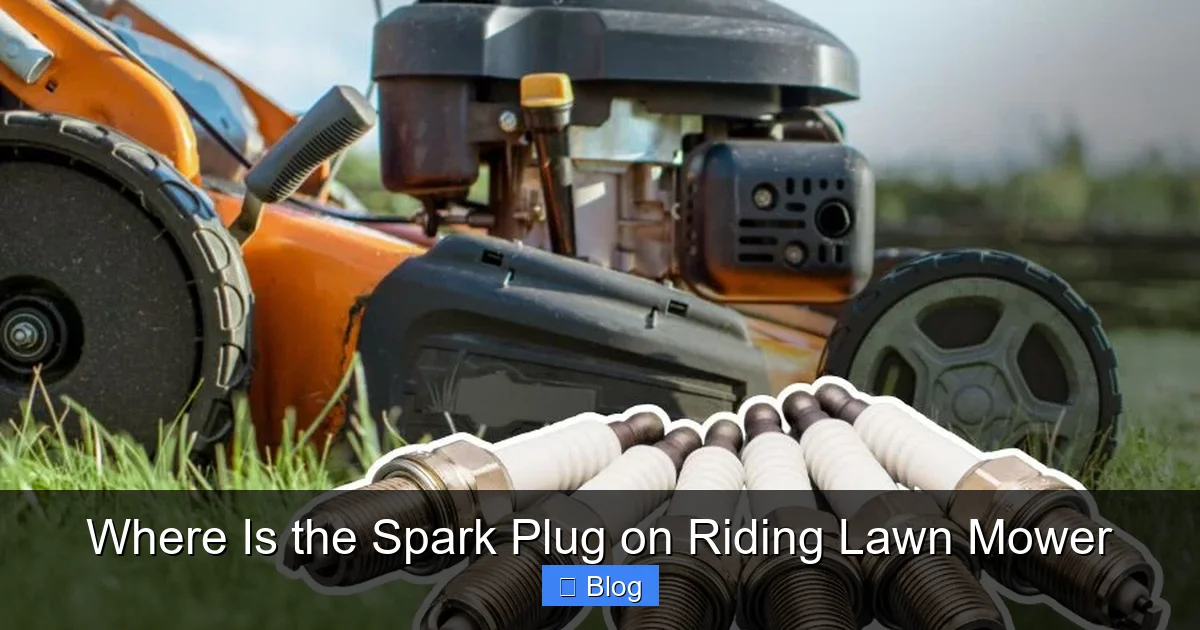
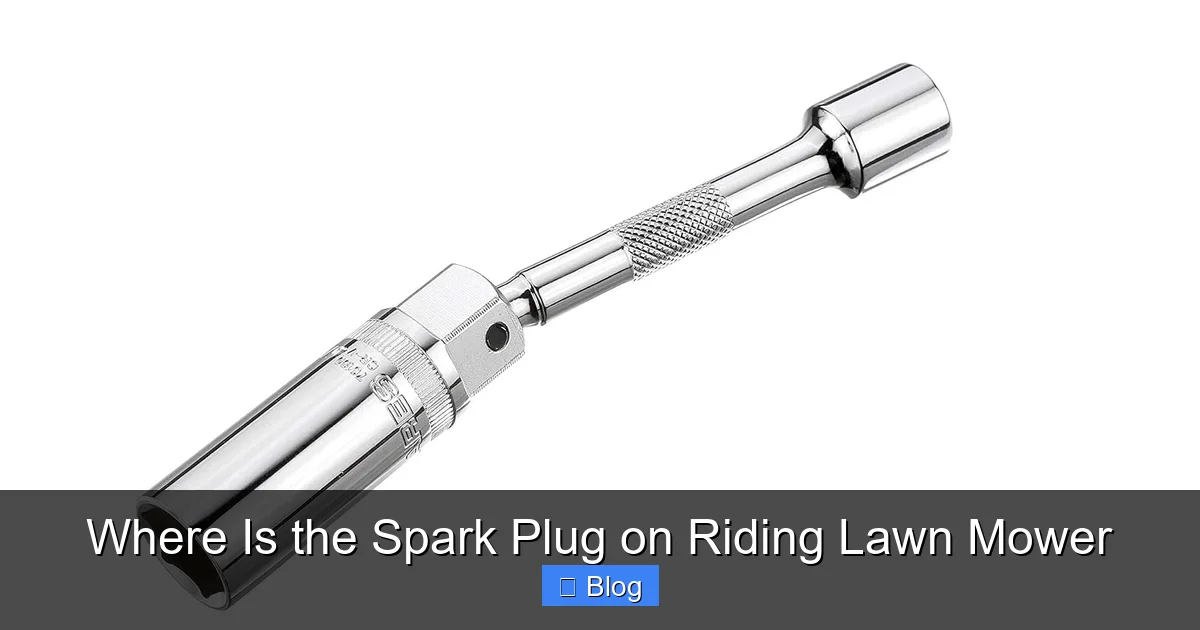
- Spark Plug Wrench or Socket Set: Spark plugs typically require either a 5/8-inch or 13/16-inch socket. A dedicated spark plug socket often has a rubber insert to protect the porcelain insulator and hold the plug during removal/installation.
- Ratchet: To attach to your spark plug socket for leverage.
- Extension Bar: Many spark plugs are recessed, requiring an extension to reach them.
- Flashlight or Headlamp: Engine compartments can be dark, and a good light source is crucial for seeing into tight spaces and locating the spark plug.
- Air Compressor or Brush: To clear debris around the spark plug before removal, preventing it from falling into the combustion chamber.
- Rags or Shop Towels: For cleaning up any oil or grime.
- Owner’s Manual: Your mower’s manual is an invaluable resource, often containing diagrams showing the exact location of the spark plug on your specific model.
Understanding Your Engine: Common Types and Layouts
The exact “where is the spark plug on riding lawn mower” answer largely depends on the type of engine your mower utilizes. Riding mowers typically come with one of two main engine configurations: single-cylinder or V-twin.
Visual guide about Where Is the Spark Plug on Riding Lawn Mower
Image source: images-na.ssl-images-amazon.com
Single-Cylinder Engines
These are the most common on smaller to mid-sized riding mowers. As the name suggests, they have one cylinder. The spark plug will be located on the side of that single cylinder head. Depending on the engine’s orientation, it could be facing forward, backward, or to one side. These engines are generally simpler to work on.
V-Twin Engines
Found on larger, more powerful riding mowers, V-twin engines have two cylinders arranged in a “V” shape. This means there will be two spark plugs – one for each cylinder. You’ll typically find one spark plug on each side of the engine block, often symmetrical in their placement. Accessing both can sometimes be slightly more challenging due to frame components or other engine accessories.
Engine Orientation
Riding mower engines are often either vertical shaft (common) or horizontal shaft (less common for mainstream riding mowers, but seen). This largely impacts how the engine sits in the chassis and thus, how accessible the spark plug is. However, regardless of shaft orientation, the spark plug will still be directly connected to the cylinder head.
Locating the Engine on Your Riding Mower
This might seem obvious, but knowing where your engine is housed is the first step to finding the spark plug. Most riding lawn mowers have their engines located in one of two primary areas:
Under the Hood (Front-Engine Mowers)
The vast majority of traditional riding lawn mowers are front-engine models, where the engine is located at the front of the mower, typically under a removable hood or cover. To access it, you’ll usually need to lift the hood (often latched or hinged) or remove a cover plate.
Under the Seat (Rear-Engine Mowers)
Some smaller riding mowers, often referred to as “rear-engine riders,” have their engine mounted behind the driver’s seat. Accessing the engine and thus the spark plug on these models often involves lifting the seat or removing a rear panel. Zero-turn mowers also typically have their engines at the rear, often exposed or under minimal cowling.
Identifying the Spark Plug: What It Looks Like
Once you’ve located the engine compartment, you’re looking for a very specific component. The spark plug itself is a small, cylindrical part, usually with a white ceramic (porcelain) insulator at one end and a metal threaded body. However, what you’ll typically spot first is its connection: the spark plug wire and boot.
| Engine Type | Typical Location | Identification Tip |
|---|---|---|
| Single-Cylinder (Front-Engine) | Usually on the front or side of the engine block, near the top of the cylinder head. | Look for a single, thick rubber wire (boot) directly attached to the engine block. |
| V-Twin (Front-Engine) | One on each cylinder head, often on opposing sides (e.g., left and right) of the “V” shape. | You will find two thick rubber wires, each leading to a spark plug. |
| Rear-Engine Rider (Single-Cylinder) | Often at the front or side of the engine, which is located under the seat or rear cover. | May require lifting the seat or removing a rear panel for visibility. |
| Zero-Turn Mower (V-Twin) | Typically at the rear, one on each side of the V-twin engine. Often more exposed. | Generally easier to spot due to less cowling compared to front-engine riders. |
The spark plug wire is a thick, rubbery, insulated cable that leads from the ignition coil (or magneto) directly to the spark plug. At the end of this wire is a rubber or plastic boot that snugly fits over the top of the spark plug, creating a waterproof and electrically insulated connection. This boot is often black, but can sometimes be red, blue, or another color.
Follow this wire. It will lead you directly to the spark plug. The spark plug itself will be screwed into the cylinder head of the engine. You’ll usually see the top of the spark plug, including the ceramic insulator and the metal terminal where the boot connects, protruding from the engine block.
Spark Plug Location Quick Reference
Step-by-Step: Pinpointing the Spark Plug
Now that you understand the general principles, let’s go through the practical steps to locate the spark plug on your specific riding lawn mower.
Step 1: Prepare Your Mower and Work Area
Reiterate and confirm all the safety steps: mower off, key removed, parking brake engaged, engine cool, spark plug wire disconnected and tucked away. Ensure you’re working in a well-lit area with enough space.
Step 2: Lift the Hood or Seat to Expose the Engine
For most front-engine riding mowers, gently lift the hood. It may have latches, clips, or simply lift and pivot forward. For rear-engine or zero-turn mowers, you might need to lift the seat or remove a small access panel (check your manual if unsure how to open it). This gives you the best view of the engine compartment.
Step 3: Locate the Spark Plug Wire(s)
Scan the engine block for a thick, insulated, rubbery wire (or two, if you have a V-twin engine). This is the high-tension lead that delivers electricity to the spark plug. It will typically be black, but sometimes red or blue, and will be notably thicker and more rigid than other wires in the engine bay.
Step 4: Follow the Wire to the Spark Plug
Once you’ve identified the spark plug wire, follow it with your eyes and hands. It will lead directly to a rubber or plastic boot that is firmly attached to a component screwed into the engine block. This component is your spark plug. It will often be located on the side of the cylinder head, sometimes slightly angled.
- For Single-Cylinder Engines: There will be one wire leading to one spark plug.
- For V-Twin Engines: There will be two wires, each leading to a separate spark plug, usually on opposite sides of the engine block.
Step 5: Examine the Engine Block and Cylinder Head
If the spark plug wire is obscured or you’re having trouble tracing it, visually scan the cylinder head area of your engine. The cylinder head is the top part of the engine where the combustion takes place. The spark plug must be screwed into this part to reach the combustion chamber. Look for the distinct ceramic insulator portion of the spark plug itself, which often stands out against the metal engine.
Step 6: Dealing with Obstructions
Sometimes, the spark plug might be partially hidden by other engine components like air filters, fuel lines, or shrouds.
- Air Filters: You might need to temporarily remove the air filter housing for better access. These are usually held on by a few screws or clips.
- Engine Covers/Shrouds: Some engines have protective plastic or metal covers that need to be removed to expose the spark plug. These are usually secured with bolts or clips.
- Wiring/Hoses: Gently move any flexible wires or hoses out of the way, being careful not to kink or damage them.
Always note how you disassembled something so you can reassemble it correctly.
Step 7: Confirming Your Find
Once you’ve located what you believe to be the spark plug, visually confirm it. It should match the description: a small, cylindrical component with a porcelain insulator and a metal body, with the spark plug wire’s boot securely attached to its top. You can gently tug on the boot (after disconnecting the wire completely) to ensure it’s indeed the spark plug.
When You Can’t Find It: Troubleshooting Tips
Even with a good guide, some riding lawn mower models can be tricky. If you’re still asking “where is the spark plug on riding lawn mower” after following the steps, don’t give up!
Consult Your Owner’s Manual
This cannot be stressed enough. Your riding mower’s owner’s manual is the definitive guide to your specific machine. It will almost always contain detailed diagrams or photos showing the exact location of the spark plug, along with specifications like the correct spark plug type and gap. If you don’t have a physical copy, most manufacturers offer free PDF versions for download on their websites.
Look for Specific Engine Brand Markings
Many riding mowers use engines from specific manufacturers like Briggs & Stratton, Kohler, Kawasaki, or Honda. These engines often have their brand name prominently displayed. Searching online for “spark plug location [your engine brand] [engine model number]” can yield specific diagrams or videos.
Check for Hidden Engine Covers
Some newer mowers or those designed for a very clean aesthetic might have additional plastic shrouds or covers that completely enclose parts of the engine. These might be secured with screws, clips, or even simply snap into place. Gently feel around for seams or fastening points that indicate a removable cover.
Consider Tilting or Lifting the Mower (with extreme caution)
For some engine configurations, particularly those with horizontal shaft engines or very tight spaces, slightly tilting the mower (ENSURE FUEL TANK IS LOW TO AVOID SPILLS AND NEVER TILT MOWER WITH FUEL CAP DOWN) or lifting it with a jack (supported by jack stands for safety) can provide better access or visibility. Only do this if you are confident in doing so safely and have proper equipment. Refer to your owner’s manual for safe tilting angles.
Use a Flashlight
A bright flashlight or headlamp is your best friend in a cramped engine compartment. Shine the light from different angles, peering into crevices. The spark plug’s porcelain insulator often has a distinct color that might catch the light.
Why Finding Your Spark Plug Matters
Beyond just a maintenance task, knowing where your spark plug is located is crucial for several reasons:
- Routine Maintenance: Spark plugs are wear items. They need to be inspected, cleaned, and replaced periodically (usually annually or every 100 operating hours) to ensure optimal engine performance and fuel efficiency.
- Troubleshooting: A faulty or fouled spark plug is a common cause of engine problems like misfires, rough idling, hard starting, or a lack of power. Checking the spark plug is often the first diagnostic step.
- Engine Performance: A correctly gapped and clean spark plug ensures a strong, consistent spark, leading to better combustion and smoother engine operation.
- Fuel Economy: A worn or dirty spark plug can lead to incomplete combustion, wasting fuel and increasing emissions.
Conclusion
Locating the spark plug on your riding lawn mower might initially seem like a daunting task, but by following the safety precautions, understanding your engine type, and methodically searching for the spark plug wire, you’ll find it with confidence. Remember, the spark plug is a vital component for your mower’s health and performance. Regular inspection and maintenance of your spark plug will not only extend the life of your engine but also ensure your riding lawn mower is always ready to tackle your lawn care tasks efficiently. So, take pride in your newfound knowledge, and keep your mower running like new!

Sagor Jahan is the founder and author of Automopromo.com, dedicated to delivering insightful tips, reviews, and updates in the automotive and promotional industry. With a passion for innovation and clear guidance, Sagor helps readers make informed decisions and stay ahead in the ever-evolving automotive world.

